
When does a price become interesting?
A price alert is more than an email. The useful question is: When is buying worth it in historical context? Smart price alerts connect thresholds with price history, historical lows, and price rating, so you can judge offers with context instead of reacting only to discount badges.
Why fixed price limits often fall short
“Alert me below €700” sounds clear, it rarely is. Without context you do not know whether €700 is near a historical low or far above it. A fixed limit ignores trend, volatility, and seasonal movement.
- Arbitrary targets: Not every wish number is market-realistic.
- Missing history: The alert fires, but the price was already cheaper yesterday.
- Discount blindness: A sale can sit above average and still look “discounted.”
- One-day lows: A single dip is different from a level that keeps coming back.
How smart price alerts work
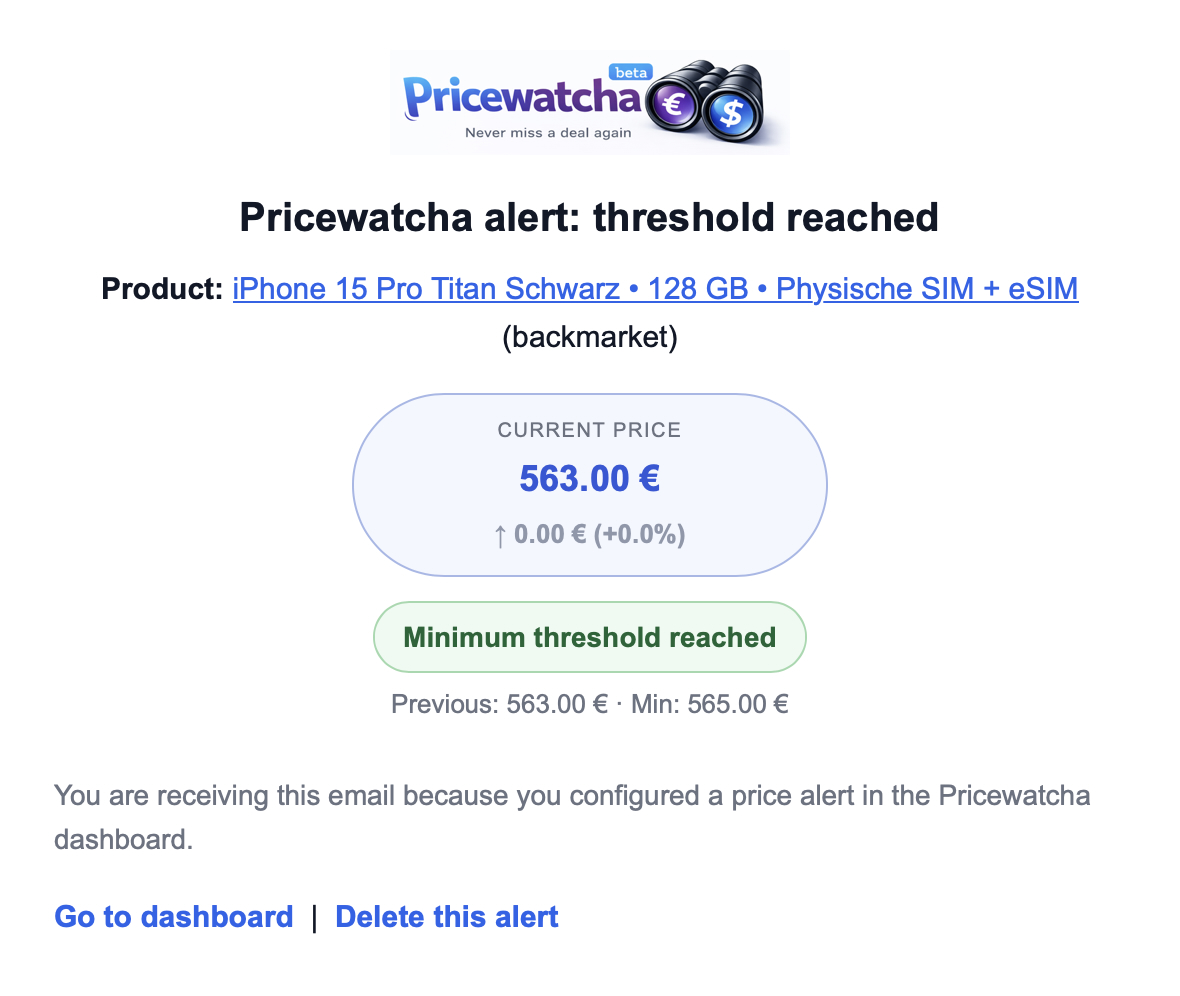
In the price dashboard you have two options: Price drops / Price rises (direction of the latest change, no fixed euro amount; “Price drops” is on by default for new products) and optional fixed under / over limits with Save. You can combine both. Pricewatcha checks prices on a schedule (currently about every 6 to 24 hours, depending on the shop) and emails you.
The difference from a plain notification: you configure the alert in the context of a growing watchlist, with history, recent moves, and comparison alongside other offers. Step-by-step details in the Help & FAQ.
Why historical prices matter
Without historical price data, every threshold is a guess. The captured history shows average, low, and trend, the basis for a realistic target price and for deciding whether an alert makes sense at all.
If you know the historical low, you do not set alerts at €749 when the product regularly drops below €700 during sales. More on context in smart price analysis.
When a price is interesting
A price is analytically interesting when several signals align:
- Near the low: The price sits in the lower part of the tracked range.
- Below average: Not only briefly, but clearly under the usual level.
- Falling or stable trend: No spike just before a known sale period.
- Watch volatility: With high swings, a slightly more conservative target can make sense.
- Plan for season: Black Friday and year-end sales move many tech prices, timing can make alerts more meaningful.
Price knowledge over impulse: The alert marks the moment, rating comes from history. Only both together turn a notification into a data-driven buying decision.
Combining price alerts with price histories
The sensible flow: track the product, let history build, then set a threshold, not the other way around. In your dashboard you see all tracked products; in price analysis you read trend and historical metrics. The alert reacts when your target is reached.
- Maintain a watchlist: Multiple shops and listings in parallel, e.g. refurbished and new.
- Adjust thresholds: Different targets per product and budget.
- Verify after alert: Availability, condition, shop, the captured price is a data point, not a checkout guarantee.
Example: price alert for a refurbished iPhone
You want a refurbished iPhone 15 Pro, budget around €680, but only if the price is attractive in context:
Without context: Alert at €680, the price dips to €679 during a 24-hour promotion, you buy, even though the average over recent weeks was €710 and refurbished offers regularly drop below €650 during sales.
With price knowledge: You track two refurbished listings plus a new device for comparison. History shows: historical low at €645, average €705, higher volatility before November. You set the alert at €660, near the lower range, but reachable. When it fires, you check price analysis for trend stability. More on the market: buy a refurbished iPhone.
The same logic applies to a MacBook or any product with meaningful volatility: derive thresholds from data, not gut feeling.
Common questions about price alerts
How do price alerts work?
Two kinds in the dashboard: toggles Price drops / Price rises (email when the price moves meaningfully vs. the previously recorded price, no euro amount; “Price drops” on by default for new products) and optional fixed under / over limits with Save. You can combine both. Pricewatcha checks prices on a schedule and emails you, ideally with price history and historical context.
What’s the difference between “Price drops” and “under …”?
Price drops / Price rises react to the direction of the latest price change. under … / over … react to a fixed amount you choose (e.g. under €500), regardless of whether the price just moved up or down.
What is a realistic target price?
A level near the historical low or in the lower part of the tracked range, not an arbitrary wish number. If you know average and trend, you set thresholds the market can actually reach.
When do prices typically change?
For electronics and refurbished devices, often after model refreshes, during sale events such as Black Friday, or when individual shops move stock. Prices can swing daily or weekly, sometimes only briefly.
Why is a discount badge alone not enough?
Because percentage badges often rely on inflated reference prices. An alert without historical context can fire too early, or too late when the discount still sits above the usual range.
How do you spot good deals?
When the price sits near a historical low, stays below average, and the trend is not spiking upward before a known sale period. Alerts mark the moment, price analysis provides context.
Price information and availability may change. The merchant's price is always authoritative.
Start tracking prices with Pricewatcha
Create a free account, add your first product link and monitor prices across shops with alerts and price history.